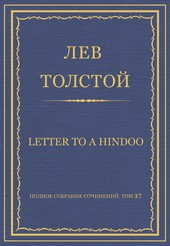
На нашем сайте вы можете читать онлайн «Полное собрание сочинений. Том 37. Произведения 1906–1910 гг. Letter to a Hindoo». Эта электронная книга доступна бесплатно и представляет собой целую полную версию без сокращений. Кроме того, доступна возможность слушать аудиокнигу, скачать её через торрент в формате fb2 или ознакомиться с кратким содержанием. Жанр книги — Серьезное чтение, Классическая литература, Русская классика. Кроме того, ниже доступно описание произведения, предисловие и отзывы читателей. Регулярные обновления библиотеки и улучшения функционала делают наше сообщество идеальным местом для любителей книг.
Полное собрание сочинений. Том 37. Произведения 1906–1910 гг. Letter to a Hindoo
0 баллов
0 мнений
6 чтений
Автор
Дата выхода
30 января 2014
Полное собрание сочинений. Том 37. Произведения 1906–1910 гг. Letter to a Hindoo читать онлайн полную книгу - весь текст целиком бесплатно
Перед вами текст книги, разбитый на страницы для удобства чтения. Благодаря системе сохранения последней прочитанной страницы, вы можете бесплатно читать онлайн книгу Полное собрание сочинений. Том 37. Произведения 1906–1910 гг. Letter to a Hindoo без необходимости искать место, на котором остановились. А еще, у нас можно настроить шрифт и фон для комфортного чтения. Наслаждайтесь любимыми книгами в любое время и в любом месте.
Текст книги
The second «scientific» justification is, that as amongst plants and animals a struggle or existence goes on which always culminates in the survival of the fittest, the same struggle should go on amongst men (notwithstanding that men are beings endowed with the attributes of reason and love, faculties which are absent from beings submitting to the law of struggle and selection). In this consists the second «scientific» justification of violence.
The third scientific justification of violence the most prominent, and unfortunately the most widespread, is in reality the oldest religious justification only a little altered which is the theory that the use of violence in social life against some, for the welfare of others is inevitable, and, however desirable love amongst people might be, coercion is indispensable.
Such are the scientific vindications of coercion.
Meantime the unhappy majority weighed down by toil, is so dazzled by the display which accompanies the propagation of these «scientific truths», that, under this new influence it accepts them as readily as it formerly accepted the pseudo religious justifications and continues to submit slavishly to new potentates who are just as cruel as the former one, but who have some what increased in number.
V
Who am I? I am that which thou hast searched for since thy baby eyes gazed wonderingly upon the world, whose horizon but hides this real life from thee. I am that which in thy heart thou hast prayed for, demanded as thy brithright, although thou hast not known what it was.
Мнения
Еще нет комментариев о книге Полное собрание сочинений. Том 37. Произведения 1906–1910 гг. Letter to a Hindoo, и ваше мнение может быть первым и самым ценным! Расскажите о своих впечатлениях, поделитесь мыслями и отзывами. Ваш отзыв поможет другим читателям сделать правильный выбор. Не стесняйтесь делиться своим мнением!
Другие книги автора
Понравилась эта книга? Познакомьтесь с другими произведениями автора Лев Толстой! В этом разделе мы собрали для вас другие книги, написанные вашим любимым писателем.