На нашем сайте вы можете читать онлайн «Все науки. №6, 2022. Международный научный журнал». Эта электронная книга доступна бесплатно и представляет собой целую полную версию без сокращений. Кроме того, доступна возможность слушать аудиокнигу, скачать её через торрент в формате fb2 или ознакомиться с кратким содержанием. Жанр книги — Техническая литература. Кроме того, ниже доступно описание произведения, предисловие и отзывы читателей. Регулярные обновления библиотеки и улучшения функционала делают наше сообщество идеальным местом для любителей книг.
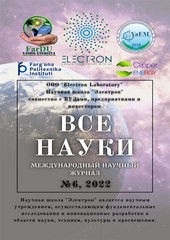
Все науки. №6, 2022. Международный научный журнал
0 баллов
0 мнений
11 чтений
Автор
Дата выхода
03 ноября 2022
Краткое содержание книги Все науки. №6, 2022. Международный научный журнал, аннотация автора и описание
Прежде чем читать книгу целиком, ознакомьтесь с предисловием, аннотацией, описанием или кратким содержанием к произведению Все науки. №6, 2022. Международный научный журнал. Предисловие указано в том виде, в котором его написал автор (Ибратжон Хатамович Алиев) в своем труде. Если нужная информация отсутствует, оставьте комментарий, и мы постараемся найти её для вас. Обратите внимание: Читатели могут делиться своими отзывами и обсуждениями, что поможет вам глубже понять книгу. Не забудьте и вы оставить свое впечатие о книге в комментариях внизу страницы.
Описание книги
Международный научный журнал «Все науки», созданный при OOO «Electron Laboratory» и Научной школы «Электрон», является научным изданием, публикующим последние научные результаты в самых различных областях науки и техники, представляя собой также сборник публикаций по вышеуказанным темам коллегами авторов и рецензируемый редколлегией на платформе «Ридеро» ежемесячно.
Все науки. №6, 2022. Международный научный журнал читать онлайн полную книгу - весь текст целиком бесплатно
Перед вами текст книги, разбитый на страницы для удобства чтения. Благодаря системе сохранения последней прочитанной страницы, вы можете бесплатно читать онлайн книгу Все науки. №6, 2022. Международный научный журнал без необходимости искать место, на котором остановились. А еще, у нас можно настроить шрифт и фон для комфортного чтения. Наслаждайтесь любимыми книгами в любое время и в любом месте.
Текст книги
The target plate consists of arranged atoms and let a certain number of charged particles enter inside. If we place a reference frame at the beginning of the target, then we can use the following statement that the particles will pass through some part of the target, which begins at a certain coordinate and ends at the coordinate of the sum of this coordinate and the thickness of the part itself, and the thickness is equal to the difference of these coordinates.
The question arises to this condition: how many incoming charged particles will enter into the interaction? To do this, we indicate that there are N (x) particles at the first coordinate, and dN at the end point N (x), respectively, where dN is the number of interacting charged particles.
Let’s determine the number of cores in this segment of two coordinates – x and x+dx, if the thickness between them is dx. To do this, we introduce the value of the density of nuclei, which determines the number of nuclei of a substance per unit volume, it is defined as the ratio of the density of a substance to its atomic mass in kg and changes into a nucleus / m3 (2).
To determine how many cores there are at a specified point, it is enough to multiply this value (2) by the volume in this part of the plate, for this its area is multiplied by the thickness and by (2), which is indicated in (3).
But what is the area, once in which the core will get into the interaction? For one nucleus, we introduce the concept of the nuclear effective cross section, the same region, and since the actions take place in a circle relative to the nucleus of an atom, this value is determined by (4).
Thus, the area available for interaction is (5).
But the ratio of this area to the entire area of the plate is equal to the ratio of the number of all particles remaining without interaction to the total number of particles, that is, it is true (6).
Now, we introduce a numerical definition for (6), and for this we integrate both parts (7) separately into (8) and (9), and then we get the overall result (10).
From here we can get the value of the interacting particles (11).
And the output power can also be calculated thanks to (12).
Hence, a jump in power is obtained, that is, a resonance when approaching the energy of the Coulomb interaction in a nuclear reaction.
Мнения
Еще нет комментариев о книге Все науки. №6, 2022. Международный научный журнал, и ваше мнение может быть первым и самым ценным! Расскажите о своих впечатлениях, поделитесь мыслями и отзывами. Ваш отзыв поможет другим читателям сделать правильный выбор. Не стесняйтесь делиться своим мнением!
Другие книги автора
Понравилась эта книга? Познакомьтесь с другими произведениями автора Ибратжон Хатамович Алиев! В этом разделе мы собрали для вас другие книги, написанные вашим любимым писателем.


Похожие книги